At a recent conference, roughly 50 credit union leaders were asked a simple question: Among trust, digital experience, data, personalization, human interaction and other potential sources of competitive advantage, what will create the greatest competitive advantage for credit unions over the next five years? The top answer: trust.
That surprised me. Digital experience, data, personalization and human interaction were all options, but trust came out on top.
Trust is certainly important in financial services. But I suspect credit union executives and their members have very different ideas about what it means to trust a financial institution. And that difference helps explain why credit unions are losing ground to large banks and fintechs in the battle for consumers' primary financial relationships.
My take: Credit unions have spent decades building trust around their cooperative structure, community involvement and commitment to members' best interests. At the same time, banks and fintechs have been building trust by making consumers' financial lives easier and innovating product offerings. While credit unions proclaim their sincere intent to advocate for members, they’re losing brand equity and market share in dimensions of trust that matter most to consumers.
The Three Dimensions of Trust in Banking
Every financial institution claims to be trustworthy, but the problem with trust as a competitive differentiator is that it's a vague concept. In actuality, there are three distinct areas of trust that influence consumers' financial relationships:
-
Security: Consumers trust an institution to protect their money and personal information. They expect their deposits to be safe, transactions to be accurate, fraud to be detected and problems to be resolved.
- Experience: Consumers trust an institution to make their financial lives easier. They expect an app that works, payments that go through, quick hassle-free account opening, money that moves quickly and the ability to do business without jumping through hoops.
- Advocacy: Consumers trust an institution to act in their best interests. They expect sound advice, appropriate product recommendations and guidance that helps them make better financial decisions, even when those decisions aren't the most profitable ones for the institution.
Credit unions have traditionally emphasized trusted advocacy, with trusted security largely taken for granted. Their member-owned structure, community orientation and commitment to financial well-being are supposed to distinguish them from profit-driven banks.
But there's a problem with that positioning: It assumes consumers place the same relative value on these three dimensions of trust that credit unions do. And that assumption is simply outdated.
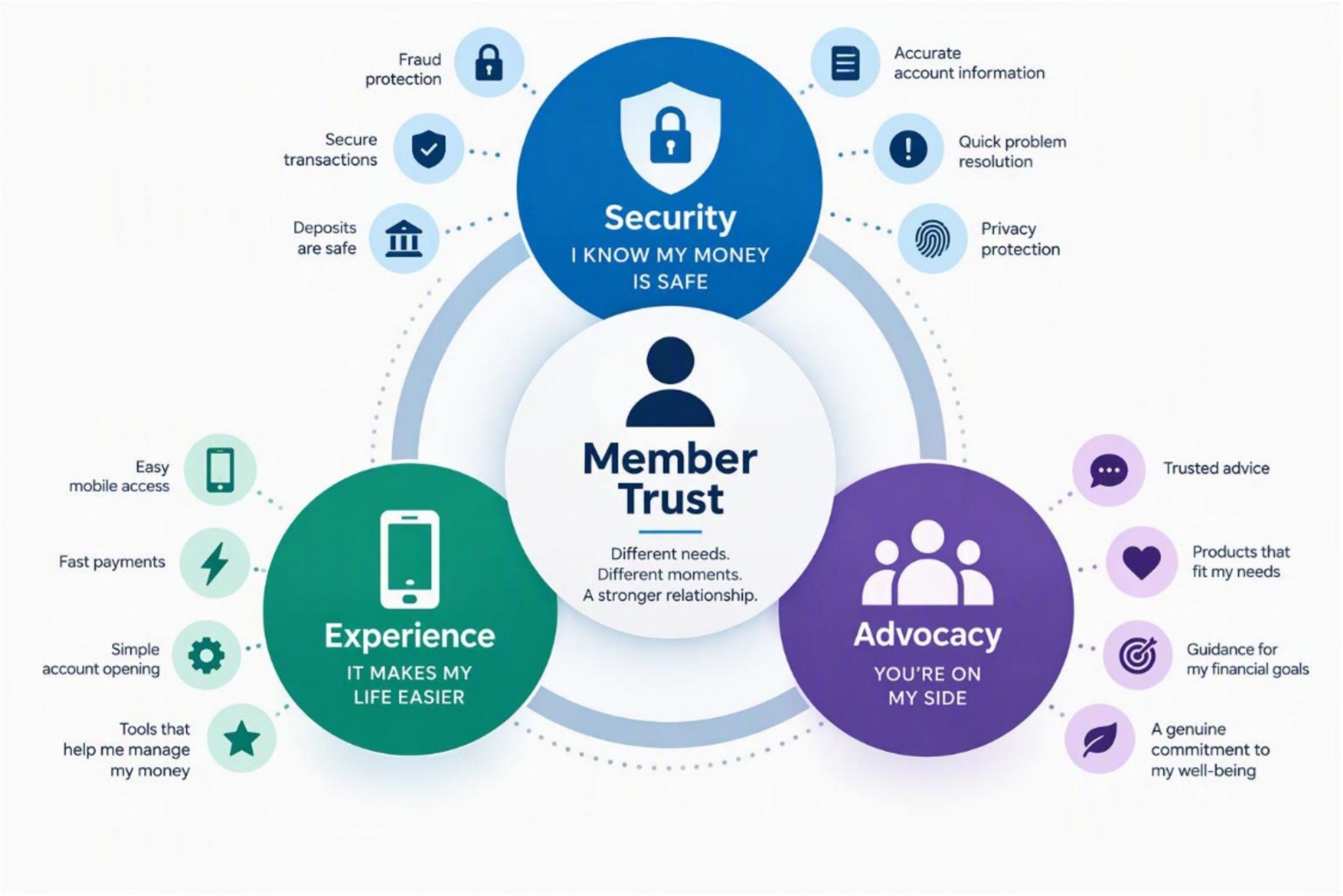
Consumers Vote with Their Wallets
When credit union members who opened fintech accounts were asked why they chose a fintech over a bank or credit union, the leading reasons were:
- 44%: Lower or no fees
- 43%: Ease of mobile access
- 40%: Cashback or rewards
- 35%: Early direct deposit
None of these reasons suggests that consumers have lost faith in their credit union's integrity or commitment to members' interests. But they do suggest that those attributes aren't always enough to win their business.
A member may trust a credit union to provide good financial advice but trust a big bank like Chase to deliver a better everyday banking experience. That same member might also trust Chime to provide faster access to a paycheck or another fintech to offer better tools for managing spending.
This is an important distinction, because consumers don't necessarily have one trusted financial institution. They trust different providers to do different things.
And increasingly, that's exactly how they're managing their financial lives.
If Members Trust You, Why Does Their Money Go Somewhere Else?
My colleague Ron Shevlin has written before about consumers' "shadow financial lives"—the financial activity that takes place outside their primary bank or credit union.
A consumer may maintain a checking account at a credit union while using another institution's credit card, a fintech's payment app, an online bank's savings account, and a brokerage firm's investment platform. From the credit union's perspective, that person is still an active member. From the consumer's perspective, the credit union is one of several financial providers—but not necessarily the favorite.
The member may genuinely like the credit union, recommend it to friends, and believe it acts in their best interests. Yet none of that prevents them from moving more of their financial activity elsewhere.
Trusted Advocacy Doesn't Guarantee Primacy
Recent checking account acquisition numbers illustrate the problem. According to J.D. Power data for Q2 2026, Chase captured 11.2% of new checking account openings, followed by Chime at 11%, Wells Fargo at 8.7% and Bank of America at 8.1%. Navy Federal Credit Union, the only credit union among the leading institutions shown, captured 1.8%.
Granted, checking account acquisition is influenced by a lot more than trust, including marketing spending, distribution, pricing and brand awareness. But that's precisely the point. Trust may be necessary to get consumers to open an account; other factors determine where they actually open one.
Let's stop pretending that consumers who open accounts at Chase or Chime are doing so despite a lack of trust in those institutions. They're demonstrating trust in those providers' ability to meet specific financial needs.
The competitive challenge for credit unions is that they may be earning one type of trust while their competitors are earning the types that drive account acquisition, usage and primacy.
Credit Unions Have a Self-Serving Definition of Trust
I can already hear the objections from credit union executives. Member ownership matters! Community commitment matters! Putting members' interests first matters!
I agree. But here's what bothers me about the industry's fixation on trust: Credit unions have defined it largely around the attributes they believe make them different and assume consumers value most. That's a convenient way to define a competitive advantage. It’s just not particularly objective.
A consumer making a complicated borrowing decision may place a high value on trusted advocacy. Having someone who understands their financial situation and can help them make the right decision could be the deciding factor.
But a consumer who wants to deposit a check, transfer money or pay a bill may care a lot more about a trusted experience. That consumer isn't evaluating the institution's cooperative philosophy. They want to get something done quickly, easily and accurately.
And for someone worried about fraud or the safety of their savings, trusted security may outweigh everything else. A large bank's size, technology capabilities and perceived stability could be more reassuring than a credit union's local presence.
Different consumers value different forms of trust. Even the same consumer will prioritize them differently depending on the financial task at hand.
The implication should be obvious: Large banks and fintechs aren't operating under a trust disadvantage. They've built competitive advantages around forms of trust that credit unions have underemphasized.
Digital Experience Is How You Build Trust
This brings me back to the conference question. The audience was asked to choose from among several sources of competitive advantage. But there's a fundamental problem with that list. Digital experience, data, personalization and human interaction are ways financial institutions collectively establish and reinforce the dimensions of trust. Treating them as separate sources of competitive advantage overlooks how trust is developed and maintained.
Consider the idea of a trusted experience. When a credit union can provide a member with the ability to open an account in minutes, move money without friction and resolve a problem without calling three different departments, it demonstrates that it can be relied on to make the member's financial life easier. Every successful interaction reinforces that confidence, while every frustrating experience gives the member another reason to consider alternatives.
The same principle applies to trusted security and being a trusted advocate for the member. A credit union that uses data to identify opportunities to save members money, avoid unnecessary fees or make better borrowing decisions demonstrates that it's acting in their best interests. Strong fraud detection and security capabilities reinforce confidence that the institution can protect a member’s money. And when members face complicated financial decisions, knowledgeable employees who provide useful guidance can strengthen the relationships that credit unions have traditionally considered their greatest advantage.
Credit unions have spent years talking about digital transformation as a means of improving efficiency and meeting changing consumer expectations. But they should recognize that investments in technology, data and personalization also influence how much consumers can trust them—and what consumers can trust them to do. Improving the digital experience and leveraging data strategically can create the confidence members need to consolidate more of their financial activity at the credit union.
This is where the industry's discussion of trust needs to evolve. Credit unions can't assume that members will reward them with more business simply because they believe the institution has their best interests at heart. They must demonstrate, through the products, services and experiences they deliver, that they're capable of handling a greater share of members' financial lives.
Trust Is Earned. Primacy Is the Payoff
Maybe the 50 credit union leaders were right. Trust could be a major source of competitive advantage over the next five years. But the industry's traditional, single-dimension approach to building trust won't be sufficient.
Credit unions can't rely on their cooperative structure, local presence or history of member service to convince consumers that they deserve a greater share of their financial lives. Those attributes may give them a head start with some members, but they don't guarantee that members will choose the credit union when a better alternative comes along.
The industry needs to stop measuring the strength of its relationships primarily through satisfaction, loyalty and trust scores. A member who gives the credit union a 10 out of 10 for trusted advocacy but keeps most of their deposits, payments and borrowing activity elsewhere isn't much of a competitive success story.
The questions credit unions should be asking are more specific:
- Do members trust us to protect their money?
- Do they trust us to make their financial lives easier?
- Do they trust us to help them make better financial decisions?
- How much of their financial activity are they willing to entrust to us as a result?
Ultimately, the biggest competitive threat facing credit unions isn't that members will suddenly stop trusting them.
It's that members will continue trusting their credit unions while increasingly trusting other providers to do more for them.
And if the industry doesn't recognize that distinction, credit unions may spend the next five years celebrating their greatest competitive advantage while watching competitors capture more of their members' business.