The financial institutions that thrive won't be the biggest. They'll be the ones that can keep investing.
A decade ago, reaching $1 billion in assets was community banking’s unofficial graduation line. Cross it, and your institution had “made it.” You could afford a deeper management team, invest through a bad year, and believe sustainable performance was yours for the foreseeable future.
There was no ceremony, but achieving this milestone meant something. Today, it means less.
An analysis of data from 2015 shows that reaching the $1 billion asset mark was not in fact an arbitrary threshold, but a meaningful inflection point for improved performance. But this milestone has shifted. By the end of 2025, the same improvement did not appear at $1 billion in assets. The meaningful jump appeared later, within the $3 billion to $5 billion band.
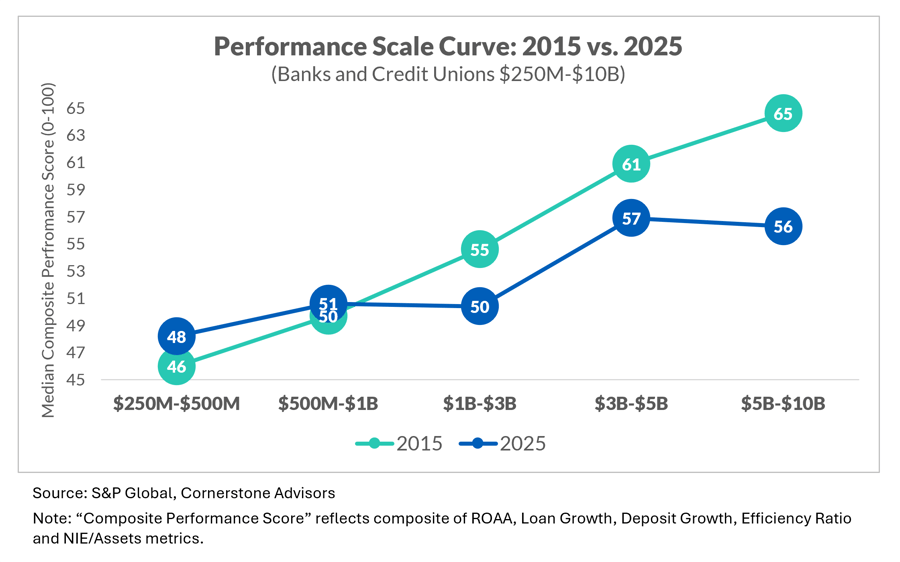
The exact numbers will vary by charter, market and business model. But the direction is clear: The price of remaining relevant has gone up.
Thousands of institutions still operate as if yesterday’s definition of scale guarantees them a tomorrow. It doesn’t.
The Unspoken Truth
The industry often confuses viability with relevance, believing a healthy community bank or credit union can remain operating indefinitely if it remains adequately capitalized and profitable.
But today's operating environment requires a level of investment and capabilities that simply weren’t necessary a decade ago. Banks and credit unions now face significant ongoing investment in digital capabilities, compliance infrastructure, cybersecurity, fraud prevention, data management and specialized operational expertise.
Let me be clear: Asset size is not the be-all and end-all. A focused $900 million institution can outperform a bloated $4 billion institution that has accumulated branches, products and vice presidents without acquiring an advantage.
But size is also not irrelevant.
Below some level, the fixed cost of modern banking consumes so much capacity that “strategy” becomes deciding which urgent problem to postpone. And while bankers often discuss scale as a cost issue, the real benefit of scale is optionality.
Optionality lets management hire specialized talent, replace weak technology and survive a credit cycle without canceling every strategic initiative. More importantly, it creates the option to say no. No to a bad vendor contract, no to a poorly timed merger offer and no to expense cuts that jeopardize the institution’s future.
That is what it truly means to have “made it”: not merely staying open but choosing your future.
The Three Levels of Scale
The difference between surviving and thriving is not measured by asset size alone. It is measured by what an institution’s size allows it to absorb, invest in and build.
- At survival scale, the institution can remain capitalized, compliant and open. But one bad credit cycle, fraud event or technology conversion can consume years of capacity.
- At reinvestment scale it can operate safely while hiring specialists, replacing technology and absorbing an occasional failed investment. That is what bankers once meant when they said a $1 billion institution had “made it.”
- At advantage scale it can invest ahead of demand and build differentiated capabilities. This is where an institution has the opportunity to thrive. Most community institutions do not need advantage scale everywhere. But they need it somewhere. Otherwise, they are selling similar products through the same vendors at similar prices.
How Big is Big Enough?
The answer is not to pick an arbitrary asset target and tell everyone to grow faster. A larger institution with no deposit engine or operating leverage has not solved the problem. It has made it bigger.
To determine the required scale to effectively compete, executives and boards should:
- Measure reinvestment capacity—Calculate how much the institution can consistently invest after funding normal operations, regulatory obligations and capital needs. Use normalized earnings, then test the result against higher deposit costs, elevated credit losses, lower fee income and a major fraud event.
If every strategic project disappears when earnings weaken, the institution does not have reinvestment capacity, it has good-weather capacity.
- Define what scale must buy—“Reach $[TARGET SIZE] by 2030” is not a strategy. Stop setting asset goals without identifying what those assets are supposed to accomplish.
Specify which capabilities become sustainable at the target size: stronger treasury management, data talent, digital acquisition or major technology replacement, etc. And ask instead: What can we afford to become at $[TARGET SIZE] that we cannot afford to become today?
Choose a Path Forward
No institution can be all things to all customers in every market. Management must choose among four paths:
- Grow: Accelerate growth until the institution can support the capabilities its strategy requires.
- Specialize: Concentrate resources where the institution can build a real advantage.
- Share: Use CUSOs, managed services, partnerships and outsourcing for capabilities that do not need to be proprietary.
- Combine: Pursue a merger when the institution lacks a credible path to sustainable reinvestment capacity.
These paths can be combined. What an institution cannot do is pursue all four half-heartedly while funding every legacy product, branch and process.
Build a Scale Plan
A growth plan focuses on the balance sheet: loans, deposits and assets. A scale plan identifies which costs will grow slower than revenue, which manual processes will disappear, and which capabilities will be built rather than rented.
If assets double and complexity doubles with them, the institution has not achieved scale; it has simply achieved a larger efficiency problem.
Establish Trigger Points
Boards should define in advance the conditions that force a change in strategy—e.g., missing deposit growth or operating leverage targets, failing to fill critical roles, lacking investment capital—and agree on those triggers before the institution is under pressure.
It is easy to defend independence when earnings are strong. The real test is whether leadership will reconsider the model when the evidence says it is no longer working.
The Reinvestment Imperative
In a world shaped by accelerating technology investment, increasing competition for deposits and talent, and rising compliance costs, the scale required to consistently reinvest will continue to shift.
The strategic question boards and management teams face is no longer, “How big are we?” It is, “Do we have the capacity to fund our future?” Institutions that can consistently reinvest in people, technology and growth opportunities will retain the ability to shape their own destiny. Those that cannot will increasingly find their strategic options narrowing.
Tristan Green is a director at Cornerstone Advisors. Follow him on LinkedIn.